Filters
Electric treadmills
Electric treadmills are a convenient way to walk, jog or run regularly, regardless of the weather, the time of day or whether you have access to a gym. They allow you to train at your own pace: do a gentle cardio workout, a faster interval session or a short walk after work. This is the ideal solution for people who want to improve their fitness, ensure they exercise regularly and have equipment ready to use whenever they actually have time to train.
In this category, you’ll find models tailored to different needs: from compact options for the home, through equipment with apps and training programmes, to larger machines designed for more intensive use. If you’re interested in a wider selection of equipment, have a look at the treadmills category too, where you can compare different types of walking and running machines.
Electric treadmills for home use and daily cardio training
Key facts (for quick selection)
This category includes electric treadmills, i.e. motorised machines that allow you to adjust your walking or running pace and train in controlled conditions.
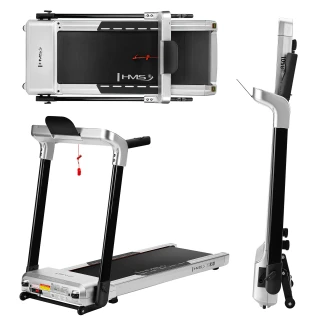
A fold-away home treadmill is a good choice for a flat, especially if you want to free up space in the room after your workout.
If you’re focused on running training, pay attention to the running belt, maximum speed, shock absorption, structural stability and incline adjustment.
For more intense sessions and more frequent use, a more robust sports treadmill or a semi-commercial model will be a better choice.
Uses
Electric treadmills are ideal for fitness training, weight loss, general fitness and health. You can use them for walking, brisk walking, jogging, running, interval training and warming up before strength training. For many people, the biggest advantage is consistency: a home treadmill allows you to train without leaving the house, regardless of the weather, temperature or travel time.
For beginners, a good place to start is walking for 20–30 minutes several times a week. More advanced users can make use of programmes, pace controls and incline settings to build endurance and intensity. A treadmill can also form part of a larger cardio area, alongside exercise bikes, rowing machines and elliptical trainers.
How to choose an electric treadmill? Key specifications
- Intended use: walking, jogging or running
If you mainly want to walk and do gentle cardio, a compact model with convenient speed control will suffice. If you’re interested in a treadmill for running, look for models with a wider running belt, a more stable frame and sufficient speed range.
- Space and Foldability
Space management is crucial in a flat. That’s why a foldable electric treadmill will be practical if you plan to keep it in the living room, bedroom or home office. Pay attention not only to the dimensions when unfolded, but also to how it folds and how easy it is to move.
- Shock absorption and stride comfort
Shock absorption is important for both walking and running. A well-chosen home electric treadmill should provide a stable stride, predictable belt movement and comfort for your joints during regular sessions.
- Incline adjustment
Incline allows you to simulate uphill sections, increase the intensity of your walk and add variety to your workout without having to significantly increase your speed. This is important if you’re looking for cardio, glute training and greater calorie burn at a slower pace.
- Programmes and apps
Training programmes help you maintain the rhythm of your sessions, whilst app compatibility can boost motivation and make it easier to track your progress. If you like to train ‘by the numbers’, choose models with a clear display, performance metrics and the ability to follow a training plan.
Electric treadmills versus mechanical treadmills
When choosing equipment, it’s worth distinguishing between electric and mechanical models. A mechanical treadmill operates without a motor, and the belt’s movement depends on the user’s effort. It may be simpler and less sophisticated, but it usually doesn’t offer as much control over pace as electric models.
An electric treadmill allows you to set the speed precisely, use programmes and often adjust the incline as well. It’s a good choice if you want a consistent workout: the same speed, the same session length, similar intensity and easier progress tracking. If you prioritise convenience and regular use, an electric model will be more practical for most home training plans.
A treadmill for running at home – when is it worth it?
A home treadmill makes sense if you want to train regularly, but the weather, a lack of time or the distance to the gym are getting in the way of your plan. Home equipment allows you to train early in the morning, in the evening or during a short break between your daily chores. This is particularly convenient in winter, when it’s raining, or when you want to avoid running on hard, uneven surfaces.
It’s worth choosing a model suited to your actual training style. For walking and light jogging, ease of use and a compact design are key. For running, the running belt, stability, maximum speed and shock absorption are what matter. If the machine is to be used by several people, also pay attention to the maximum weight capacity, adjustment options and an easy-to-read control panel.
Professional and semi-commercial treadmills
If the equipment is to be used frequently, by several people or in a small training area, it’s worth considering a more robust professional treadmill or a semi-commercial model. These types of machines usually offer a more stable build, a wider running belt, greater comfort during use and a wider range of settings to suit more demanding users.
Not everyone needs a top-of-the-range model, but it’s worth choosing equipment with some extra capacity if you plan to run regularly, do interval training or have longer sessions. In commercial and semi-commercial facilities, durability, ease of use and the ability for different users to set up their workouts quickly are particularly important.
Comparison of options
The most compact option is a treadmill designed for walking or light jogging — ideal for daily exercise and small flats. A foldable home treadmill offers greater storage convenience and is ideal where the machine cannot remain in one place all the time. A sports treadmill is the better choice if you plan to run regularly and want access to a wider range of speeds.
An electric home treadmill is the most versatile option for those who want to combine walking, jogging, running and interval training. Semi-commercial or professional models, on the other hand, are worth considering if the equipment is to be used intensively, by several people, or in a setting with a high turnover of users.
Quick set-ups
- Home – walking and consistency: a compact electric treadmill + 20–30 minutes of walking 3–5 times a week. This is a good starting point for people who are getting back into exercise and want to build a habit without putting too much strain on their bodies.
- Home – running and fitness: a stable running treadmill + a plan of 2 easy sessions and 1 interval session per week. It’s worth paying attention to shock absorption, the running belt and the speed range.
- Small space: a foldable electric treadmill + transport wheels + space to safely set up the equipment. Before buying, measure the working space, not just the storage space.
- Training area for several people: a larger sports or semi-commercial treadmill + simple training programmes + an easy-to-read control panel. This allows each user to quickly set the intensity to suit their own level.
Recommended electric treadmills in this category
• Terrun350 – an electric training treadmill with HMS two-way incline adjustment – ideal for those who want to add more variety to their training and use both positive and negative inclines. A great choice for more advanced cardio sessions, uphill walks and app-based workouts.
• Terrun275 – a home electric treadmill with HMS two-way incline adjustment (positive and negative ) – a good choice for those who want to train at home but are looking for more variety than just walking or running on a flat surface. The bidirectional incline adjustment allows you to better simulate various training conditions and add variety to your daily cardio.
• BE5872N – an electric home treadmill from HMS compatible with training apps – ideal for those who enjoy programme- and app-guided workouts. It’s ideal if you’re looking for extra motivation, to track your progress and add variety to your sessions without leaving home.
• Loop12 Multi – an electric treadmill with a desk by HMS – an option for those who want to combine exercise with working at a computer or daily activities at home. It’s ideal for a gentle walk, short exercise breaks and building the habit of ‘more steps throughout the day’.
• BE5856 HMS Premium electric treadmill – an option for those looking for a more robust model for more intensive home training. This is the choice for users who want greater comfort and performance than the most basic treadmills offer.
• BE1862 HMS Premium semi-commercial electric treadmill – a model for more demanding users and smaller training areas, where the equipment will be used more frequently and intensively. It’s worth considering if you’re looking for a wider running belt, higher speeds and a sturdier build for regular running.
FAQ
1) Is an electric treadmill suitable for a small flat?
Yes, but it’s worth choosing a model of the right size and checking whether it can be conveniently folded away or moved. The most important thing is the working area: you need space to get on and off the treadmill and to move safely whilst training. A foldable electric treadmill will work well.
2) Which to choose: a mechanical or an electric treadmill?
A mechanical treadmill is simpler, but requires you to power the belt with your own movement. An electric treadmill allows you to set the speed precisely, use programmes and control the intensity better. For regular home training, an electric model is usually more convenient.
3) Which treadmill is best for running?
For running, choose a model with a sufficiently long and wide belt, a stable frame, shock absorption and a good range of speeds. If you train several times a week, it’s better to choose a machine with a wider range of settings than a basic ‘starter’ model. It’s also worth checking the maximum user weight.
4) Is a foldable home treadmill stable?
It can be stable if you choose a model suited to your training style. For walking and light jogging, compact foldable models are often sufficient, but for regular running, it’s worth paying attention to the machine’s weight, construction and belt dimensions. Foldability is convenient, but it shouldn’t take precedence over training safety.
5) Is a home electric treadmill noisy?
The noise level depends on the design, speed, flooring and running style. In a flat, it’s a good idea to use a stable floor and a mat under the machine to minimise vibrations. When running at a faster pace, the machine and your footsteps will be noisier than when walking.
6) Does a treadmill help with weight loss?
A treadmill can support weight loss if it’s part of a regular exercise routine and a well-balanced diet. The most important factors are consistency, appropriate intensity and progress. Walking, brisk walking and running can be effective components of a cardio programme.
7) Do you need a professional treadmill at home?
Not always. A home model is sufficient for a leisurely walk and the occasional jog. A professional or semi-commercial treadmill makes sense if the equipment is to be used frequently, by several people, or for more intense running workouts.
8) How should you look after an electric treadmill?
Clean the belt and the area around the machine regularly, check the belt alignment and use the equipment in accordance with the manufacturer’s instructions. It’s also worth checking that the treadmill is stable and that the floor doesn’t transmit excessive vibrations. Regular maintenance helps to ensure a comfortable workout and extends the equipment’s lifespan.
Get started now — choose electric treadmills tailored to your training
If you want to train regularly at home, choose electric treadmills that suit your actual training plan: walking, jogging, running, interval training or daily exercise whilst working. Before buying, compare the dimensions, foldability, speed, shock absorption, incline and maximum weight capacity. This will help you choose equipment that will be comfortable not just on the first day, but throughout the months of regular training that follow.