Training cages
HMS training cages - key facts at a glance
-
Type of product range: training cages, exercise cages and training cages with lifts for home gyms and personal training studios(Training Cages).
-
Application: full-body strength training, barbell belaying, expansion of the free weights area in the home or small gym (home, semi-commercial and commercial segments depending on the model).
-
Typical parameters: height of approximately 200-230 cm, structural load capacity reaching up to 250-300 kg, multi-stage adjustment of hooks and safety beams, optional load pins and rubber band holders.
-
Related categories: Atlases, Smith cranes and overhead cranes, Gates, Benches and handrails, Stands.
-
Key criteria: intended use (home/semi/commercial), maximum load, dimensions and method of installation (wall/free-standing), range of adjustment, accessory compatibility and kit expandability.
Applications of exercise cages in the home gym
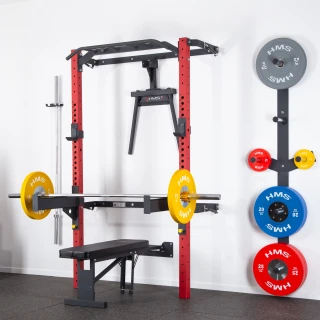
A well-chosen exercise cage allows you to build a complete set for training the entire body in one place. In a home gym, it takes on the role of several stations: barbell rack, pull-up bar, dip rails and bench base. This way, you don't have to buy many separate pieces of equipment - one stable rack becomes the focal point of your training plan. Over time, you can just add accessories and weights instead of replacing all the equipment.
Training cages are particularly useful when you are exercising alone. Being able to set the safety bars at the right height allows you to safely test heavier series - if you don't bench press or get up from a squat, the barbell will stop on the supports instead of your shoulders or chest. This provides the mental comfort that makes it easier to progress and get into new load ranges.
An exercise cage - when is a simple design enough?
A simple exercise cage will work well if you're just building a home set-up and want to focus on the basics: squats, bench presses, deadlifts and pull-ups. In such a scenario, all you need is a solid frame with barbell hooks, safety bars and a bar. Add to that a bench and a set of weights - and you have a base on which to do much of your classic strength plan.
When choosing a minimalist cage for your home gym, pay particular attention to the maximum load, base dimensions and adjustment range. Even if you exercise moderately today, in a year's time you may want to work at much higher weights. It's a good idea to have the design ready for this now, rather than forcing a quick equipment change.
Home and garage gym cage - how do you plan the space?
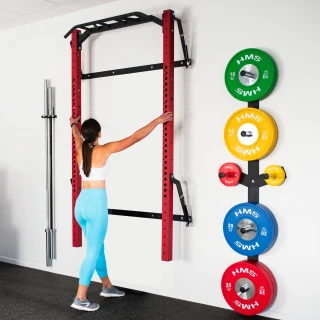
In a flat, every centimetre counts. This is where folding or smaller 'footprint' solutions work best. You can put the cage in a room, use it during your workout, and when your session is over, fold the frame closer to the wall and reclaim your living space. It's important that you leave plenty of room at the front for easy entry with the barbell and bench placement.
You can go wilder in the garage or a dedicated workout room. A freestanding gym cage with a wider base, extra posts and space for plates will allow you to create an area that visually and functionally resembles a club. It's then worth planning right away where the weights will stand, how the bench will be positioned and where you'll do the deadlift or hip thrust so they don't interfere with each other.
Training cage with a lift - who is it best for?
The training cage with a lift combines the advantages of a classic cage and a cable gate. As a result, in addition to squats and bench presses, you can perform pull-ups, pull-up rowing, arm extensions and flexions, cable stretches or rotator exercises. This is an ideal option if you like to train the whole body and appreciate the smooth transition between exercises without changing positions.
Such an option will be especially appreciated by those who have a slightly larger budget and want an 'all-in-one' - one frame that replaces several machines. A well-chosen training frame with a lift also allows you to train with a partner: one person works with the barbell, the other on the lift, and after a series you swap roles. This saves time and makes the home gym start to resemble a well-planned club area.
How do you choose a training cage? Key parameters
Purpose and load capacity of the cage
To begin, determine whether the cage will be used exclusively at home or also in a small studio or club. Home models are designed for less intensive use, but still provide a solid load capacity - usually quietly enough to train one or more people. Cages labelled as semi-commercial or commercial have reinforced profiles, thicker metal sheets and components prepared for 'non-stop' use, which you will appreciate with heavier user loads. In the category filters, you can narrow down your selection by expected load and type of use(Training Cages). HMS Fitness
Dimensions, height and depth of the training cage
Measuring the room is a mandatory step before purchasing. Pay attention not only to the height (important for pull-ups), but also to the depth of the working area. A cage that is too shallow will make it difficult to position yourself freely for squats or deadlifts. In a small room, a wall-mounted cage or a model with a smaller 'footprint' will be better; in the garage, you can afford a deeper design for greater comfort.
Adjusting the hooks and safety beams of an exercise cage
The more levels of adjustment you have, the more precisely you can match the settings to your height and the type of exercise. You'll need a different height for squats than you do for standing presses, and a different one for putting the barbell down after a deadlift. Pay attention to whether the hooks and safety easily translate, whether they have safety features to prevent accidental release, and whether you can operate them in seconds or so without having to remove half the structure. HMS Fitness+1
Accessories and expandability
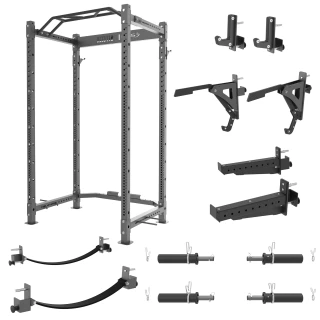
Good training cages rarely work in isolation - it's the base you expand on. Plate holders, dip rails, additional bars, rubber band holders, monolift hooks or accessory shelves make a single station 'grow' with you. In the product descriptions you will find information on which accessories fit which model; an example of an extended design is the KLT3111 KLATKA TRENING Z AKCESORIAMI HMS. HMS Fitness+1
Mounting: wall-mounted vs. free-standing
Wall-mounted cages (such as the KLT22 or KLT23 variants) take up minimal space when folded, which is a huge advantage in small flats or garages shared with a car. Freestanding structures, such as the KLT3110 KLATKA TRENING WITH COMMERCIAL HMS, can be set up anywhere in the room, and it is easier to rearrange the entire area later. Instead, they require a little more space and the often recommended anchoring to the ground.
Safety, comfort and ergonomics
Check that the edges are curved, the grip on the rod is comfortable and that welded parts do not have sharp ends. Details such as the texture of the handles, the stability of the structure during dynamic movements or the quality of the powder coating are also important. It's these 'little things' that determine whether you're happy to step up to the cage every week or start making excuses.
Related categories and typical configurations
If you're looking for additional cable work and want to complement your cage, check out the gates - modular set-ups with lifts allow for precise isolation exercises and functional training. When you're after a consistent circuit of movement and maximum assistance, consider overhead cranes and Smith cranes, which are great for completing the cage area. You can complete the set by adding benches and handrails, bars, racks and grips and weights.
For those focused on a strong lower body workout, consider combining the cage with a platform or hip thrust station - e.g. in duo with solutions from the Hip Thrust category. Such a set of equipment allows you to effectively train both classic buoys and more modern variants of exercises.
Training cages - Integrations and example models
In the HMS offer you will find both cages typically used at home, as well as constructions designed for intensive use:
-
KLT21 KLATKA FOR EXERCISE HMS - a compact exercise cage with a bar, ideal as a base for a simple home gym.
-
KLT23 TRENING CAGE RED HMS and KLT23 TRENING CAGE SILVER HMS - folding wall-mounted cages that take up minimal space when folded.
-
KLT22 WIELOFUNKCYJNA KLATKA TRENINGOWA SILVER HMS - a multifunctional training cage with an extensive set of accessories, allowing you to build a complete station in your flat or garage.
-
KLT3111 KLATKA TRENINGOWA Z AKCESORIAMI HMS and KLT3110 KLATKA TRENINGOWA WITH COMMERCIAL EQUIPMENT HMS - proposals for more demanding users and small training studios, with an extensive set of accessories and high load capacity.
These models can be combined with other HMS products from the Strength Equipment section to create cohesive, aesthetically pleasing and functional training areas.
Frequently asked questions by our customers (FAQ)
Isn't the training cage 'too big' for a flat?
Not necessarily. Many models have been designed with limited space in mind - especially wall-mounted cages that, when folded, take up just inches from the wall. If you leave room to get in with a barbell and set up a bench, even in a small room you can create a fully functional training area.
When is a simple exercise cage enough, and when is it worth investing in an exercise cage with a lift?
A simple exercise cage with a bar, hooks and safety supports will be ideal if you focus on basic buoys and don't need a large number of isolated exercises. If you like full-body training, cable work and want more options with a single station, an exercise cage with a lift will quickly show the advantage - it adds dozens of new movement variations without adding more machines.
Do I need to anchor the cage to the ground or wall?
Wall-mounted models require a solid installation according to the manufacturer's instructions - a safety requirement. Freestanding cages can often work without anchoring, especially if you put extra weight on them with plates on pins. If you do dynamic movements, use heavier weights or share equipment with other people, anchoring increases stability and comfort.
How do I choose the height of the cage for my height and flat?
Measure the height of your room and subtract the allowance for pull-ups - it's a good idea if you still have a couple of inches of slack when you grab the bar. If you're training in a low room, look for lower-profile models or ones where the bar can be mounted slightly lower. With very tall people, it's also worth considering a slightly taller design, especially if you plan to do dynamic pull-ups or rubber band work.
How are the training cages delivered and assembled?
Cages usually come in self-assembly packs, with a set of screws and instructions. Larger structures may arrive on a pallet. If you are buying for your home, you can usually do the assembly yourself, but if you are buying for a studio or a larger gym, it is worth considering the help of an assembly team - this will speed up the setting up of the equipment, the levelling of the structure and the selection of the optimum positioning in the room.
Don't wait any longer! Make a decision today and change your life!
Are you planning to create or expand your home gym and wondering which training cage will be best for your space? Write to us - we'll help you choose the model, accessories and configuration to suit your space, budget and training style.